The challenge.
Habitat for Humanity of Greater Fort Wayne reviewed paper applications by hand and prepared its board files through the spring, with delivery to the board in May. Habitat for Humanity of San Antonio and Guadalupe Valley screens about 4,000 applicants a year to serve 60 partner families, and was pulling credit reports on applicants before they had cleared basic eligibility.
What changed with Conductor.
Both affiliates moved applications online. The pre-screen runs against each affiliate's own rules, so staff time and credit reports go to families who meet the basics. Sweat equity hours are logged on the family's record and verified on site. Board and Family Selection packets are drawn from the same data staff use every day.
The outcomes.
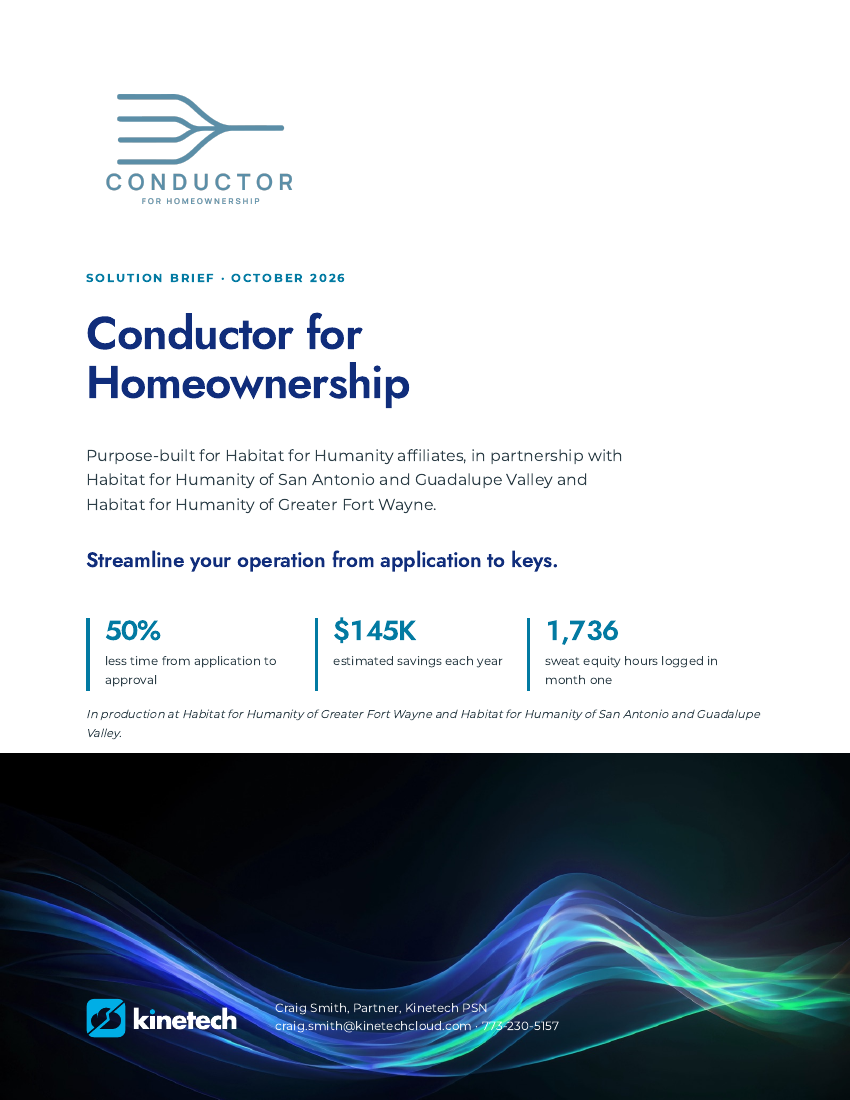
Fort Wayne cut the time from application to approval in half and delivered to its board in March instead of May. With the capacity that came back, the affiliate launched a Critical Repair program without adding administrative staff. San Antonio saves an estimated $145,000 a year, $106,000 of it on credit checks alone, and its families logged 1,736 sweat equity hours in the first month.
Running state housing finance or tax credit allocation instead? See Conductor for Housing Development.
The Kinetech system has transformed how we serve applicants. Families facing complex financial or credit barriers are automatically identified and connected with specialized partner agencies, freeing our team to dedicate its time to one-on-one counseling and giving more families a real path toward homeownership.
Assistant VP of Family Services, Habitat for Humanity of San Antonio and Guadalupe Valley