Purpose-built for the work of public service delivery.
Built for the agencies and nonprofits that run public services.
State Agencies
Running large programs across housing, energy, transit, regulatory oversight, elections, and community development. Multi-county scale, multi-program complexity, multi-year accountability.
City and County Governments
Delivering household relief, community programs, and direct services where the work happens close to the people receiving it.
Administrative Agencies
Transit authorities, utility commissions, housing finance authorities, and independent regulatory bodies running programs under their own statutory authority.
Public-Serving Nonprofits
Habitat for Humanity affiliates, Community Action Agencies, supportive housing operators, and community development organizations running programs alongside or in partnership with public agencies.
Solutions ready for household assistance, housing development, homeownership, administrative and regulatory case management, mobility, and elections. See the solutions





150+ Organizations served across the United States
More than 1 million people served across Kinetech-delivered public programs, and more than $1.5 billion in program funds distributed through those systems. Engagements include state agencies such as MSHDA and the North Carolina Department of Public Safety, counties such as Montgomery County, utility commissions, transit authorities, municipal governments, boards of elections, and nonprofit organizations administering public programs. Building and supporting public-sector and nonprofit programs since 2014, with a 100% U.S.-based team.
See our workCase management is at the core of most public programs.
What makes Kinetech case management different.
Multi-stakeholder by design.
The right people. The right information. The right time. Public programs run across applicants, providers, agency staff, oversight bodies, and the public, all touching the same case with different access. Our case management runs the work on one record with role-appropriate visibility. Most case management tools were built for a single back-office team. Public programs aren't single-team work.
Agility through runtime configuration.
Federal guidance gets updated. Appropriations shift. A new program needs to launch in six weeks. On most platforms, each of those moments means a development ticket and a waiting period. Ours was built differently. Eligibility rules, forms, workflows, and reporting templates are configured through an admin interface, not embedded in code. Your program administrator changes them. The system reflects the update immediately. Three years in, you're running the platform, not back at the procurement table for every program update.
Public sector depth that compounds.
Building public sector software since 2014. Our solution catalog is assembled from reusable modules refined across more than 150 engagements. Eligibility patterns, document workflows, fund-tracking logic, federal reporting integrations: all of it has been built before. A Kinetech implementation isn't a first-time build.
Partnership model, not dependency model.
Most vendor relationships are designed around dependency. The vendor's revenue depends on the agency needing them for routine changes, so the platform stays opaque enough that the agency can't run it on its own. Kinetech operates on the opposite model. The agency owns the configuration layer. Kinetech supports, maintains, and enhances the platform as the agency directs, not as a condition of operating it. Dependency isn't our business model. Partnership is.
The ten capabilities behind our household assistance solution, and what changes for an agency because of them, in one short document.
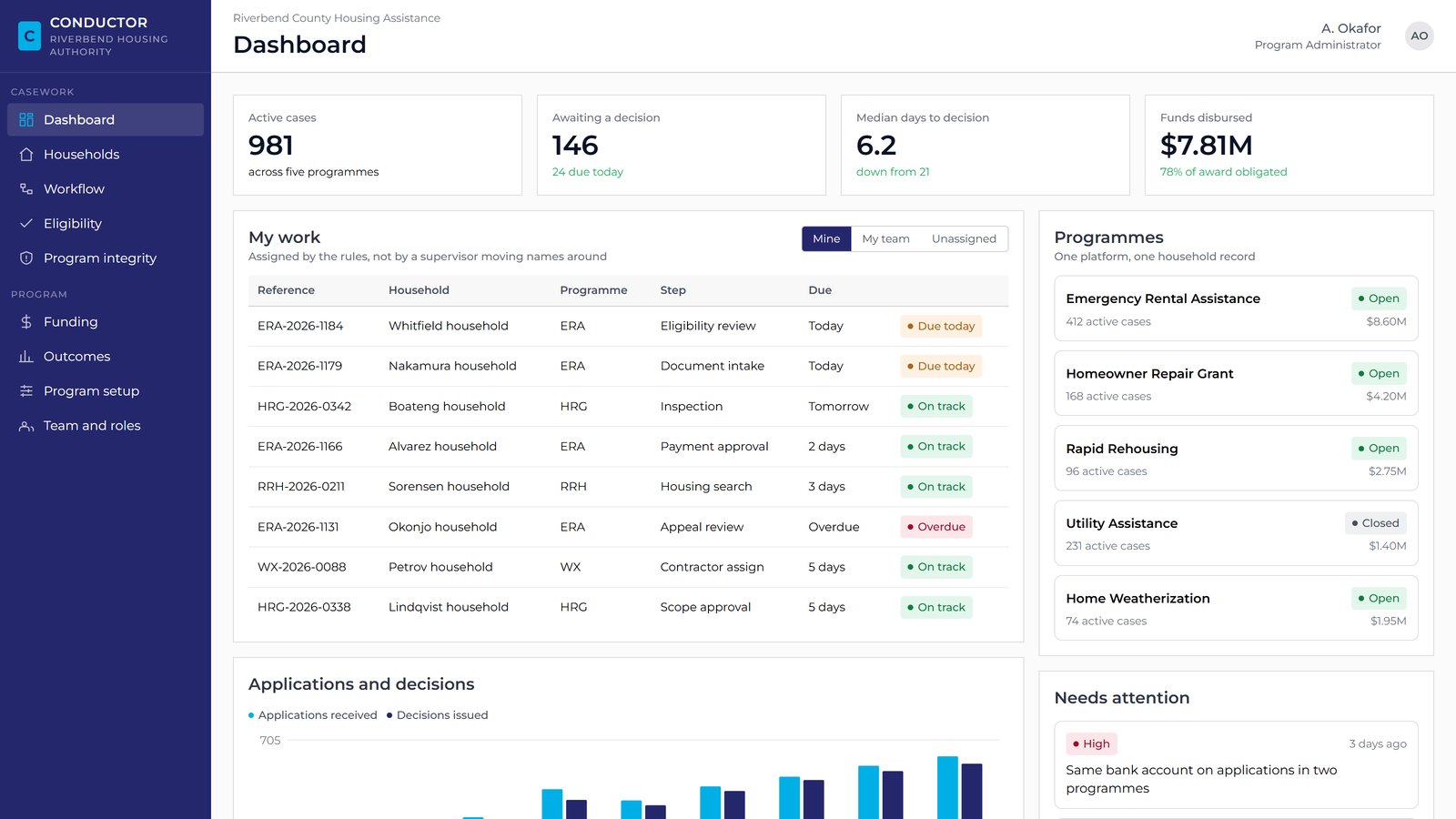
Conductor is the platform we build all of our case management solutions on.
Configured, not coded
Program rules, forms, routing, and reporting are configured by agency staff, not embedded in code by developers. When policy changes, program staff update the rules through an admin interface. The system reflects the change immediately.
It sits above the systems you already have
An agency keeps the tool that already works and still gets a unified view of its programs, without a second migration, a second retraining, or a year of risk. Where the existing tools work, they stay. Where the gaps are, Conductor closes them.
Your team owns the configuration
Once the platform is in production, your team owns the configuration layer: forms, eligibility rules, workflows, reporting templates, and program-specific data structures. Kinetech supports, maintains, and enhances the platform as the agency directs.
Conductor case management solutions.
Your program is different? No problem. Conductor is agile and configurable. When a program's operational shape doesn't fit one of the solutions above, Kinetech builds it on the same platform, from the same library of modules: intake, eligibility, case management, document processing, fund tracking, audit, reporting, identity, and payments. A custom build isn't starting from scratch. It's starting from a proven foundation. Talk to us.
Two engagement models, depending on how your agency wants to operate the platform.
White-Glove SaaS
We provide a single SaaS license, tailor support to your needs, and deploy on the cloud you choose. One subscription, one vendor, one invoice. Kinetech runs the platform; your team runs the program.
Enterprise PaaS Enablement
Conductor is built on Mendix. If you are a Mendix customer, or want other low-code applications alongside your case management, we deliver Conductor as a platform. For agencies building internal Mendix capability and/or replatforming many applications, we augment your team to set up architecture and governance, migrate or integrate as required, and use our Conductor solution modules to accelerate deployment. We train your developers as we work. Your team takes the platform forward. Your team controls the roadmap.
Established vehicles. Faster engagement.
Artificial Intelligence Solutions for Public Sector Entities. Nationwide. Valid through 2027, renewable through 2030. Verify the contract at txshare.nctcog.org.
DBITS Software Services. Texas state and local agencies.
COTS product purchases through SHI. Texas agencies.
Held by Spatial Integrated Systems, with Kinetech as teaming partner. The route for federal agencies.
Education, municipal, and nonprofit agencies. Available nationwide.
Agencies can engage Kinetech through established cooperative and federal purchasing vehicles. When the fit is clear, the right vehicle gets the work started without a full solicitation cycle. Not sure which vehicle fits your scope? Contact Craig Smith at craig.smith@kinetechcloud.com or 773-230-5157.
Public programs run under serious requirements.
Federal authorization
Built on a FedRAMP Moderate authorized platform. Applications can be deployed into FedRAMP Moderate or High environments where a contract requires it; commercial cloud as standard. NIST SP 800-53 alignment. StateRAMP-aligned deployment available for state and local programs.
Security certifications
SOC 2 Type II. ISO 27001. AES-256 encryption at rest. TLS 1.2+ in transit. SAML, OAuth, OpenID Connect, MFA, and role-based access control.
Accessibility
WCAG 2.1 Level AA across public-facing and staff-facing interfaces. Section 508 compliance through that baseline. Screen reader testing on critical workflows before release.
Domain-specific compliance
HIPAA, CJIS, and applicable state regulatory frameworks are supported through configuration.
Deploy on AWS GovCloud, Azure Government, commercial cloud, or a private cloud, matched to the program's infrastructure and compliance requirements.
Our impact across the United States.
Michigan State Housing Development Authority
500,000+ applications processed and $1.2 billion distributed across the state's federal household assistance programs, with federal performance targets met ahead of schedule and $360 million in additional performance-based federal funding earned for the state.
City of San Antonio
Emergency household relief during the COVID-19 response. A fully digital process where caseworkers can quickly provide feedback and help prevent residents from becoming homeless.
Utah Transit Authority
FTA-funded Section 5310 eVoucher platform in production, coordinating riders, providers, and payments across the region. Kinetech Mobility eVoucher and Rideshare builds on that work.
1 million+ people served and $1.5 billion+ distributed across Kinetech-delivered household assistance programs.
Frequently asked questions.
The questions a first conversation usually starts with. If yours isn't here, Craig will answer it directly.
What is Kinetech's track record in the public sector?
What makes Kinetech different from a traditional software vendor?
Is the platform secure for government data?
Where is the development team located?
How do you handle accessibility (Section 508) requirements?
How can our agency purchase Kinetech solutions?
How long does it typically take to see results?
Will our staff be able to manage the system themselves?
Does our agency have to replace our entire legacy system?
Does Kinetech use Artificial Intelligence?
The first conversation is where this starts.
Tell us about your program. If you're running a public program and looking to address operational challenges, we'll share what we've seen work in programs like yours and where we think Kinetech can help. If there's a fit, we go deeper. If there isn't, we'll point you toward what might serve you better.
Agencies can engage Kinetech through established cooperative and federal purchasing vehicles. When the fit is clear, the right vehicle gets the work started without a full solicitation cycle.
Craig Smith, Partner, Kinetech PSN craig.smith@kinetechcloud.com 773-230-5157