<img height="1" width="1" style="display:none" src="https://www.facebook.com/tr?id=1128054299183456&amp;ev=PageView&amp;noscript=1"> Regulatory and Administrative Case Management | Kinetech Conductor
Conductor for Regulatory Case Management

Regulation runs on procedure. Your case system should too.

One governed case record from the first filing to the final order, and everything the order requires afterward. Filings, assignments, deadlines, requests for information, documents, and orders all live on the same case. Already running regulatory work in production at a large state utility commission that oversees more than 5,000 utilities.
5,000+
Utilities under the commission's oversight
21,000+
External stakeholders engaged through the platform
100 days
To baseline delivery, on schedule
Live at a state public utility commission. Contested case work across five divisions.
Built for the agencies that run on procedure.
Public utility and public service commissions
State regulatory agencies
Professional licensing boards
Ethics and oversight commissions
Permitting departments
Administrative hearing offices
The Problem

Most agencies keep their procedure in several places at once.

A regulatory or administrative case carries statutory deadlines, due process steps, and a record that courts, legislatures, and the public may examine. Most agencies spread that record across a filing system, a document store, shared calendars, spreadsheets, and email. Cases slip in the gaps.

Deadlines are kept by hand in a calendar that knows nothing about the case.
Filings arrive in one system and staff re-key them into another to start work.
Who owns a case lives in email threads and a manager's memory.
Division boundaries are enforced by convention, not by the system.
Open-records requests are expensive because the history has to be rebuilt by hand.

One record. Deadlines that know the case.

Conductor puts it all on one record. Deadlines are calculated from where the case actually stands, not copied into a separate calendar.

How a Case Moves

From filing to compliance on one record.

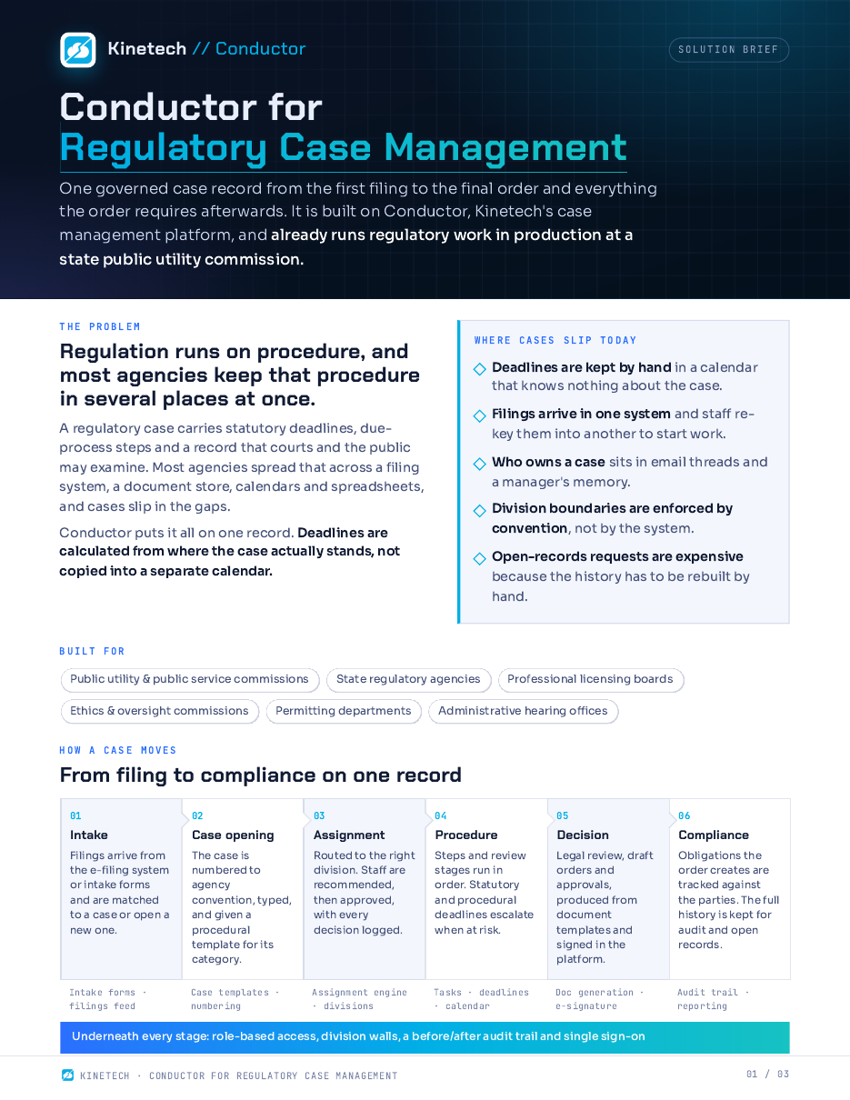
Six stages, one case. Each stage is configured to your procedure by program staff, not coded.

01 · Intake

Filings arrive from your e-filing system or intake forms and are matched to a case or open a new one.

02 · Case opening

Numbered to your docket convention, typed, and given the procedural template for its category.

03 · Assignment

Routed to the right division. Staff are recommended, then approved, with every decision logged.

04 · Procedure

Steps and reviews run in order. Statutory and procedural deadlines escalate when at risk.

05 · Decision

Legal review, draft orders, and approvals, produced from templates and signed in the platform.

06 · Compliance

Obligations the order creates are tracked against the parties. The full history is kept for audit and open records.

Underneath every stage: role-based access, division walls, a before-and-after audit trail, and single sign-on.

Who It's For

Built for the agencies that run on procedure.

One case engine, configured to the vocabulary and procedure of each kind of agency. Also configurable for permit lifecycles and tax and revenue workflows.

Filers, intervenors, staff, and commissioners on one docket.

  • Rate cases, certificate and siting proceedings, complaints, rulemakings, and compliance filings across energy, water, and telecommunications.
  • Every filing matched to its docket from the commission's own e-filing feed.
  • Statutory and procedural deadlines calculated from the case, escalated when at risk.

Each referring agency's procedure, configured as its own case type.

  • Appeals, benefit disputes, enforcement actions, and matters referred from other agencies.
  • Every order, deadline, and decision on one governed record that holds up to appeal and open-records review.
  • Hearing officer seats filled from a daily queue, with caseload in view.
  • Full detail on the Administrative Hearings page, linked under the customer story below.

Investigative files walled off from the people who decide the case.

  • Complaints against licensees, investigations, disciplinary hearings, and sanctions.
  • Access enforced on every record, not just on screens.
  • License applications and renewals can be configured on the same platform.

Investigators and commissioners each see only what their role allows.

  • Complaints, investigations, advisory opinions, and enforcement for campaign finance, lobbying, and conflict-of-interest matters.
  • Every decision on the record, with a before-and-after audit trail.
  • Advisory opinions and enforcement actions written from templates and signed in the platform.
Capabilities

What your agency gets on day one.

Configured for regulatory procedure, not written from scratch.

Dockets and case records

One record per case, numbered to your convention, with a procedural template for each category so a new category launches without a software release.

Filings and intake

A feed from your existing e-filing system that matches filings to open cases. Nothing is re-keyed.

Deadlines that know the case

Procedural, statutory, and internal deadlines on one calendar, calculated in business or calendar days, synced to staff calendars.

Assignment and workload

Every seat on a case gets a decision: assign, defer, or decline. Caseload views keep anyone from being overloaded.

Divisions and access

Divisions share the same system while their working files stay walled off from each other. Access is enforced on every record, not just on screens.

Linked work

When one person finishes, the next person is told to start. Nobody has to chase.

Orders and documents

Letters, notices, and draft orders written from templates, reviewed in the platform, and signed electronically.

Record, audit, and reporting

An unalterable audit trail of every change. Caseload, workload, and duration reporting, with a feed to Power BI or Excel for oversight.

Every capability above is configuration on the Conductor platform, delivered and extended in two-week sprints.

Proven in Production

Running regulatory work at a large state utility commission.

5,000+
Utilities under the commission's oversight
21,000+
External stakeholders engaged through the platform
100 days
To baseline delivery, on schedule
5 divisions
On one case record, each with its own walled caseload

The challenge.

A state commission that oversees more than 5,000 utilities ran contested case work across five divisions, with filings in one system, documents in another, and deadlines counted by hand.

What changed with Conductor.

Conductor manages contested case work across all five divisions. New cases arrive overnight from the commission's filing system with their filings and service lists already attached. A final-order filing is detected automatically and starts the post-order countdown. Assignments go through a recommend-then-approve step where the division requires it, and each decision is logged against the case. The commission's existing systems stayed in place; Conductor runs the case work on top of them.

The outcomes.

One view of the case: a milestone rail from intake to closure, with activity, filings, service list, documents, deadlines, and history on one page. Each division sees its own caseload; cases outside a user's division stay out of reach. A user guide organized by role, generated from the live application, so it stays in step with each release. Delivered and extended in two-week sprints, with each release tested under every user role.

Hearing office or adjudicating agency? See Conductor for Administrative Hearings and Adjudication.

Talk to Our Team About This Deployment
Why Conductor

Built to be defended.

Regulatory systems answer to courts, auditors, and the public, so what the system does has to be visible and defensible.

See it

Access is declared per role and per record, so reviewers can see exactly who can read or change what, instead of taking the vendor's word for it.

Prove it

Every release is exercised as each real user role before it ships. A passing build alone doesn't count as done.

Change it

New case categories, steps, templates, and assignment rules are configuration, so rule changes don't wait for a re-platform.

The configuration is yours. The roadmap is yours.

How We Deliver

Configured first, then extended where your agency is different.

Two-week sprints from a mapped Sprint 0 to hypercare, with your staff testing real procedures under their own roles.

Sprint 0

Your procedures, case categories, roles, and divisions are mapped into configuration.

Delivery sprints

Two-week sprints with working software at each review, integrations built early, and access verified on every build.

Acceptance testing

Your staff test real procedures under their own roles.

Hypercare

Stabilization after go-live, a handover to support, and a user guide for every role.

Working with Kinetech

Run it where it suits the agency.

Two ways to engage. You can move between them later without changing products.
Option 01

White-Glove SaaS

We provide a single SaaS license, tailor support to your needs, and deploy on the cloud you choose. One subscription, one vendor, one invoice. Kinetech runs the platform; your team runs the program.

Option 02

Your cloud or data center

Deploy to your own public, government, or private cloud, or on premises. Kinetech operates it there or supports your team. You can move between models later without changing products.

Purchasing vehicles

Established vehicles. Faster engagement.

TXShare Cooperative MSA #2025-018

Artificial Intelligence Solutions for Public Sector Entities. Nationwide.

Texas DIR Contract DIR-CPO-5958

DBITS Software Services. Texas state and local agencies.

GSA Multiple Award Schedule GS-35F-160CA

Held with Kinetech as teaming partner. The route for federal agencies.

Texas TIPS Cooperative #220105

Education, municipal, and nonprofit agencies. Available nationwide.

Building an internal platform team? See how Kinetech works with agency developers on the Kinetech PSN page.

Conductor for Regulatory Case Management Solution Brief cover
Get the Deeper Detail

Get the Conductor for Regulatory Case Management Solution Brief.

The full picture in three pages: how a case moves from filing to compliance, the capabilities an agency gets on day one, the state utility commission deployment, how Kinetech delivers, and the hosting and licensing options.

Compliance & Security

Built to the standard your program has to meet.

SOC 2 Type II · ISO 27001, 27017, 27018 · NIST SP 800-53 · HIPAA-ready · WCAG 2.1 AA and Section 508. Built on a FedRAMP Moderate authorized platform. Applications can be deployed into FedRAMP Moderate or High environments where a contract requires it; commercial cloud as standard. Your agency retains exclusive ownership of all data, documents, configuration, and audit logs, with real-time access through an OData connector for Power BI or Tableau, and structured exports plus a Certificate of Data Destruction on exit.

SOC 2 Type II
ISO 27001
ISO 27017 / 27018
NIST SP 800-53
FedRAMP Moderate authorized platform
HIPAA BAA Supported
WCAG 2.1 AA / Section 508

Certifications and attestations

SOC 2 Type II, ISO 27001, ISO 27017, and ISO 27018. Reports are available on request to support agency vendor risk assessments.

FedRAMP where the program requires it

Built on a FedRAMP Moderate authorized platform. Applications can be deployed into FedRAMP Moderate or High environments where a contract requires it; commercial cloud as standard for programs without a federal authorization requirement.

NIST SP 800-53 and StateRAMP

Applications inherit platform-level control implementation and add engagement-specific controls. Delivery aligns with StateRAMP Moderate where required by state contract.

HIPAA

Business Associate Agreements are supported. Encryption, access controls, audit logging, and breach notification align with the HIPAA Security and Privacy Rules where an application processes protected health information.

Accessibility, WCAG 2.1 AA and Section 508

Accessibility is designed in from the first sprint, not audited at the end. Automated scanning runs every sprint, and screen reader testing with NVDA, JAWS, and VoiceOver covers critical workflows before release. An Accessibility Conformance Report in VPAT format is produced as a delivery artifact.

Encryption and access

TLS 1.2 or 1.3 in transit and AES-256 at rest. Every environment uses an isolated database instance. Permissions are enforced at the data model, so a restricted user cannot reach protected data even through an API.

Cloud agnostic. Deploy on the cloud you choose. Azure, Google Cloud, and agency-controlled environments are supported alongside AWS.

Get Started

See it on a real procedure.

Bring one case category. We'll show it running in Conductor, from filing to final order.

Already know it fits? Conductor is available through GSA (GS-35F-160CA), Texas DIR (DIR-CPO-5958), TXShare (#2025-018), and TIPS (#220105), so we can start without a full solicitation cycle.

Craig Smith, Partner, Kinetech PSN craig.smith@kinetechcloud.com 773-230-5157
Ready to see Conductor on one of your case types?