
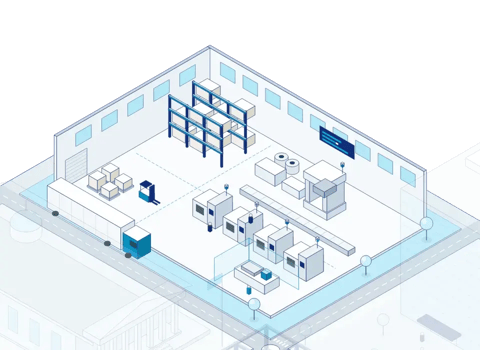
 ManufacturingPlant floor
 Public SectorAgency
 ConstructionStruXure.co
 Custom DevelopmentOffice

Your shop floor generates data around the clock.
Most of it goes nowhere.
DetectDiagnoseAct
Your machines log every cycle, every fault, every deviation from spec. Your MES captures the timestamps. Your SCADA system watches the temperature, the throughput, and the idle time.
And still, when something goes wrong at 2 AM, the first person who knows is the one who walks onto the floor at 7.
Your software was built to record, not to respond.
Kinetech builds the layer that bridges that gap. No 18-month migration. No rip-and-replace.
Industry challenge
Nobody budgets for losses they can't measure.
That's exactly what makes them so expensive.
$50 billion
Annual cost of unplanned downtime across U.S. manufacturing²
1.9 million
Projected manufacturing job shortfall by 2033¹
Siemens puts the average cost of unplanned downtime between $250,000 and $2 million per hour, depending on sector and scale.³
That's the number you can see.
P&L
MeasuredUnmeasured
- MeasuredUnplanned downtime$250,000–$2 million per hour
The real damage sits below it.
- Defectsinspection is manual and sample-based
- Wrong machinenobody knew it was running slow
- Rush partsemergency maintenance at premium rates
- Idle capacityon one line while a neighboring line runs shorthanded
- Knowledgewalks out the door when a 30-year veteran retires
- UnmeasuredDefectsinspection is manual and sample-basedNo line item
- Wrong machinenobody knew it was running slowNo line item
- Rush partsemergency maintenance at premium ratesNo line item
- Idle capacityon one line while a neighboring line runs shorthandedNo line item
- Knowledgewalks out the door when a 30-year veteran retiresNo line item
- MeasuredUnplanned downtime$250,000–$2 million per hour
- 1UnmeasuredDefectsinspection is manual and sample-basedNo line item
- 2Wrong machinenobody knew it was running slowNo line item
- 3Rush partsemergency maintenance at premium ratesNo line item
- 4Idle capacitywhile a neighboring line runs shorthandedNo line item
- 5Knowledgewalks out the doorNo line item
- Defectsinspection is manual and sample-based
- Wrong machinenobody knew it was running slow
- Rush partsemergency maintenance at premium rates
- Idle capacityon one line while a neighboring line runs shorthanded
- Knowledgewalks out the door when a 30-year veteran retires
None of this gets its own line on the P&L. It gets absorbed as normal.
According to the World Economic Forum, leading factories using AI and advanced analytics have hit productivity gains exceeding 50%.⁴
Your 24/7 digital supervisor
What happens on your floor at 2 AM on a Tuesday, when your best people are home?
Without AI
- A CNC machine on Line 1 throws a fault code and goes down.
- The night-shift operator tries calling a supervisor. Gets voicemail.
- By the time the morning team manually reschedules the job, four to six hours are gone.
- The shipment is late.
With Active Intelligence
- The system has already spotted a degrading spindle bearing.
- When the machine goes down, it reroutes the high-priority job to Line 4.
- A maintenance work order goes out with the correct part number.
- By morning, the job is back on track.
The problem
Your MES was built for a world that didn't have this problem.
Most MES platforms running today were designed in the 1990s, on the Purdue Model.
When Machine 4 goes down, your MES
- will log that Machine 4 went down
- will not tell you why
- will not reassign the job
- will not generate a maintenance ticket
It will wait for a person.
You need software that knows why it happened and what to do next. That's the gap between monitoring and orchestration.
The talent crisis
Your most experienced operators are retiring.
The knowledge goes with them.
There's a machinist on your floor right now who knows how Line 3 sounds when a bearing is starting to go. When he retires, it walks out with him.
3.8 million
new positions needed over the next decade¹
Nearly half projected to go unfilled
You can't hire your way back to 30 years of floor intuition.
AI picks up on the same patterns your veteran operators developed, across every machine, every shift, without turnover.
The knowledge doesn't retire. It compounds.
The evolution
What actually changes when your shop floor can think for itself
A system of record.
A system of action.
Querying SCADA, MES, ERP, CMMS, and quality systems separately.
Context that used to take hours takes milliseconds.
"Machine 4 temperature exceeded threshold at 02:14 AM." Alert joins a queue.
"Machine 4 overheated. Job A rerouted to Line 2. Maintenance ticket created. Day-shift lead notified."
Correlation-based. Can't explain why.
Causal AI. Maps real cause-and-effect relationships.
You're reacting after downtime has started.
The issue gets handled. Often before you know it was there.
Different roles. Different wins.
- The goal
- Keep the schedule.
- The reality
- You find out a machine went down three hours ago.three hours agowithin minutes
- What becomes possible
- When a machine goes down, you can know within minutes, with a diagnosis and rerouting options already on screen.
- The goal
- Build a data architecture that connects the floor to the rest of the business.
- The reality
- You're managing systems that were never designed to talk to each other.another custom data pipelineconnect to the namespace
- What becomes possible
- A Unified Namespace built on open standards (MQTT, OPC-UA) decouples devices from applications. New tools connect to the namespace, not to each other.
- The goal
- Find the real bottlenecks. Prove your improvements actually stick.
- The reality
- Kaizen events produce gains that look good in the debrief but drift back within weeks.drift back within weekswhether it held
- What becomes possible
- Continuous, automated data collection gives you a movie instead of a snapshot.
The Kinetech implementation approach
Getting to an AI-enabled shop floor doesn't start with replacing what's working.
The ones who get it right are incremental.
- Edge gatewayMQTTOPC-UA
Phase 1
Unified Namespace
Get the Data Flowing
Nothing gets torn out.
End of Phase 1: A real-time, single source of truth across your operation.
- Root causeShadow mode
Phase 2
Causal Intelligence
Go After the Expensive Problems
We build Causal AI models for the issues with the biggest P&L impact and run them in shadow mode first.
End of Phase 2: Accurate failure predictions and a track record the team can verify.
- GuardrailsHuman
Phase 3
Agentic Deployment
Orchestrate at Scale
AI agents run workflows within guardrails calibrated to your risk tolerance, expanded as confidence grows.
End of Phase 3: A shop floor that handles predictable problems on its own.
Through all three phases, Kinetech works embedded with your operations and IT/OT teams.
Autonomy without risk
What if your AI knew when to act — and when to ask?
A Human-in-the-Loop framework is built on one principle: AI should act confidently within the boundaries your team sets.
- Source
Causal Analysis
When something drifts, the system traces the issue to its actual source.
- OperatorSupervisorEngineer
Transparent Recommendation
No black box.
Here's what's happening
Here's what's driving it
Here's our recommendation
Here's what we expect if you act on it
- RoutineHigher stakesHuman
Calibrated Action
For routine decisions, the system acts on its own. Higher-stakes calls go to a human first.
Before AI can think, your data needs to flow.
The Unified Namespace is the architectural fix: a single real-time data layer every system in your operation reads from and writes to.
The Kinetech three step approach
Ready to see what active intelligence looks like for your operation?
01 Discover
Schedule a Discovery Call (1 Hour)
Walk us through your operation. We'll identify which problems are worth solving first.
Get in Touch02 Prove
Request a Custom POC
See a working proof of concept built around your specific workflows and data.
03 Plan
Build Your Business Case
We'll help you quantify the cost of your current operational gaps and model the ROI of addressing them.
Thought series - coming soon
The AI in Manufacturing Playbook
- 01The Difference Between Monitoring and Orchestration
- 02What a Unified Namespace Does (and Doesn't Do)Coming soon
- 03How to Calculate the Real Cost of Unplanned Downtime at Your PlantComing soon
- 04Causal AI vs. Predictive AI: Why the Distinction Matters on the FloorComing soon
- 05The Talent Multiplier: What AI Can (and Can't) Preserve When Veterans RetireComing soon
- 06Human-in-the-Loop Is Not a Limitation. It's a Strategy.Coming soon
- 07How to Scope an AI Pilot That Ships WellComing soon
Frequently Asked Questions
How is AI used in manufacturing?
AI turns shop floor data into action: detecting problems, diagnosing the cause, and recommending or taking the next step. Kinetech calls this active intelligence, moving beyond traditional systems that only record what already happened.
What is active intelligence in manufacturing?
Active intelligence is AI that detects, diagnoses, and acts on production issues in real time, instead of passively logging them. Kinetech deploys it in stages, starting with a unified data foundation, then causal analysis, then supervised automation.
Can AI work with our existing MES, SCADA, and ERP?
Yes. Kinetech connects to the systems you already run using open protocols like OPC-UA and MQTT, building a unified data layer on top. You do not replace your equipment or systems to put AI to work.
Is it safe to let AI make manufacturing decisions?
Yes, because a person stays in control. Kinetech uses a human-in-the-loop approach with transparent recommendations and calibrated autonomy, so AI proposes and your team decides how much it can act on.
What does ignoring AI actually cost?
More than most plants measure. Unplanned downtime costs U.S. manufacturing an estimated $50 billion a year, and Siemens puts the cost between $250,000 and $2 million per hour. Leading factories using AI report productivity gains above 50%.
How do we start with AI without replacing our systems?
Kinetech starts with a unified data foundation on top of your existing systems, then adds causal intelligence, then supervised automation. Each phase delivers value on its own, so you build capability without replacing everything at once.
- Coykendall, J., Reyes, V., Hardin, K., Morehouse, J., & Carrick, G. (2024). Taking charge: Manufacturers support growth with active workforce strategies. Deloitte & The Manufacturing Institute. https://themanufacturinginstitute.org/wp-content/uploads/2024/04/Digital_Skills_Report_April_2024.pdf
- Napolitano, J. (2022, February 22). Unplanned downtime costs more than you think. Forbes. https://www.forbes.com/councils/forbestechcouncil/2022/02/22/unplanned-downtime-costs-more-than-you-think/
- Siemens. (2023). The true cost of downtime 2022. Senseye Predictive Maintenance. https://assets.new.siemens.com/siemens/assets/api/uuid:3d606495-dbe0-43e4-80b1-d04e27ada920/dics-b10153-00-7600truecostofdowntime2022-144.pdf
- World Economic Forum. (2025, September 16). Global Lighthouse Network 2025: World Economic Forum recognizes 12 new sites driving holistic transformation in manufacturing [Press release]. https://www.weforum.org/press/2025/09/global-lighthouse-network-2025-world-economic-forum-recognizes-12-new-sites-driving-holistic-transformation-in-manufacturing/