.png?width=246&height=70&name=Kinetech%20PM%20246%20x%2070%20(1).png)


AI IN MANUFACTURING
Your shop floor generates data around the clock. Most of it goes nowhere.
Detect > Diagnose > Act
Your machines log every cycle, every fault, every deviation from spec. Your MES captures the timestamps. Your SCADA system watches the temperature, the throughput, and the idle time.
And still, when something goes wrong at 2 AM, the first person who knows is the one who walks onto the floor at 7.
The problem isn't a lack of data. It's that your software was built to record, not to respond. Kinetech builds the layer that bridges that gap — software designed to read your existing infrastructure, reason through what it sees, and act when the situation calls for it. No 18-month migration. No rip-and-replace.
The question isn't whether AI belongs on the shop floor. It's whether you'll lead that shift or react to competitors who did.
INDUSTRY CHALLENGE
Nobody budgets for losses they can't measure. That's exactly what makes them so expensive.
$
Billion
Annual cost of unplanned downtime across U.S. manufacturing³
Hours
Average unplanned downtime per plant, per year³
Million
Most manufacturers know downtime costs money. Few have actually added it up across all its forms.
The headline number: Siemens puts the average cost of unplanned downtime between $250,000 and $2 million per hour, depending on sector and scale.⁴ The typical plant logs around 800 hours of unplanned downtime per year — roughly 15 hours a week of time and running assets producing nothing. Across U.S. manufacturing, the annual bill runs roughly $50 billion.³ And it's climbing: Siemens' 2023 data shows hourly downtime costs in automotive are up over 50% since 2019.⁴
That's the number you can see. The real damage sits below it.
Quality defects that slip through because inspection is manual and sample-based. Jobs scheduled on the wrong machine because nobody knew it was running slow. Emergency maintenance at premium rates — rush parts, overtime labor, weekend callouts. Capacity sitting idle on one line while a neighboring line runs shorthanded. And institutional knowledge walking out the door every time a 30-year veteran retires, knowledge that was never written down because nobody thought to ask.
None of this gets its own line on the P&L. It gets absorbed as normal. That's what makes it so easy to live with and so expensive in aggregate.
The manufacturers moving fastest on AI aren't chasing trends. According to the World Economic Forum's Global Lighthouse Network, leading factories using AI and advanced analytics have hit productivity gains exceeding 50%.⁵ They've run the numbers. Doing nothing costs more.
Kinetech helps you calculate your specific version of this gap — in dollars, timelines, and operational impact — and build a business case grounded in your data, not generic benchmarks.
YOUR 24/7 DIGITAL SUPERVISOR
What happens on your floor at 2 AM on a Tuesday, when your best people are home?
The real test of any manufacturing technology isn't how it performs on a well-staffed day shift. It's what happens when nobody's watching.
WITHOUT AI
A CNC machine on Line 1 throws a fault code and goes down. The job it was running is tied to a hard delivery date. The night-shift operator tries calling a supervisor. Gets voicemail.
Production stops.
By the time the morning team arrives, figures out what happened, checks which other lines can absorb the work, and manually reschedules the job — four to six hours are gone. The shipment is late. The customer is frustrated. The downstream effects — overtime, disrupted schedules on other jobs, expedited freight — keep hitting for days.
WITH ACTIVE INTELLIGENCE
Now imagine the same scenario with this approach in place.
Hours before the fault triggers, the system has already spotted something developing. Continuous monitoring of vibration, thermal, and power data points to a degrading spindle bearing.
When the machine goes down, the system doesn't wait. It checks the work order backlog, confirms that Line 4 has the right tooling and open capacity, verifies material availability, and reroutes the high-priority job. The schedule updates. A maintenance work order goes out with the correct part number. The maintenance team's phones get a prioritized alert.
By morning, the job is back on track. The production manager's dashboard shows a resolved incident — not a crisis in progress.
The technologies behind this — real-time sensor analytics, causal root cause analysis, constraint-based scheduling, autonomous workflow execution — all exist today. What's been missing is a partner with the software depth to connect them into something that holds up on a real production floor. That's what Kinetech builds.
THE PROBLEM
Your MES was built for a world that didn't have this problem.
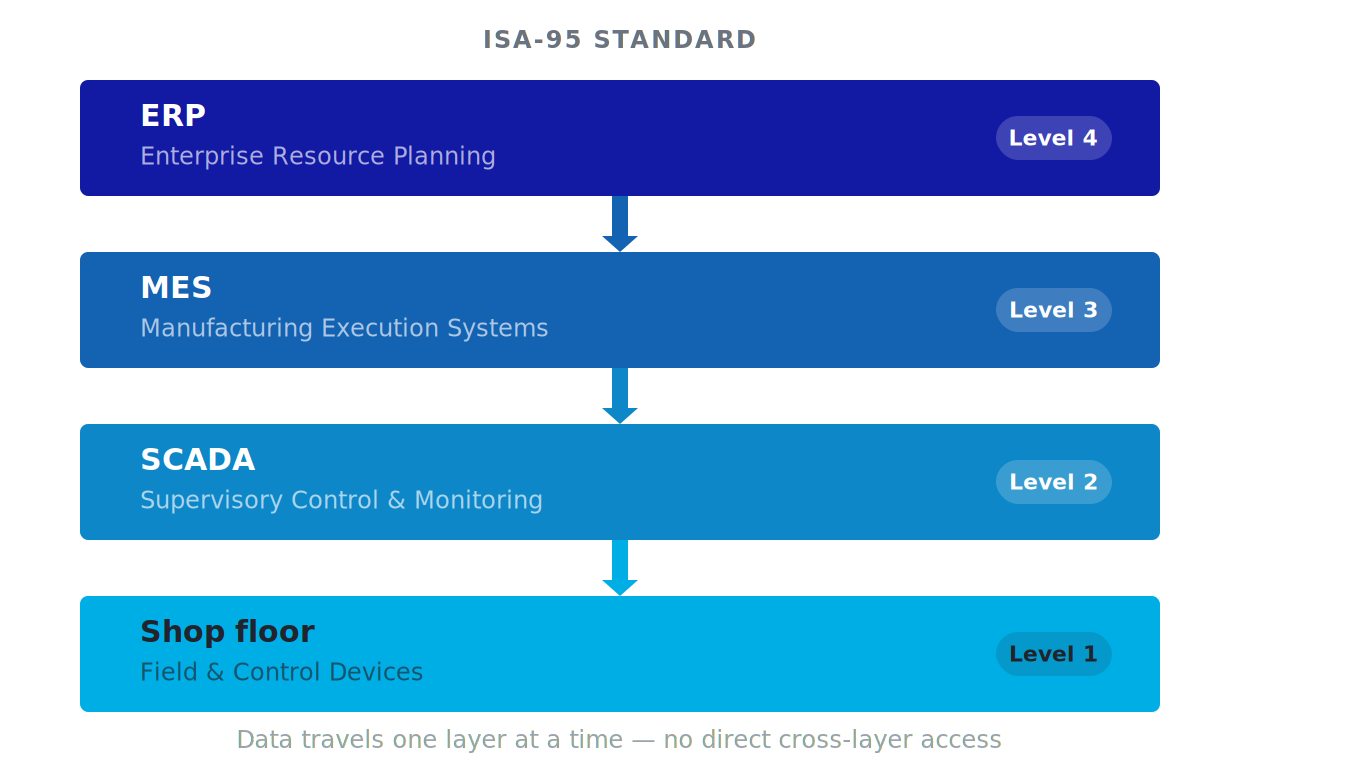
Most MES platforms running today were designed in the 1990s. They were built on a rigid, layered architecture — the Purdue Model — in which data travels up and down a hierarchy, one layer at a time, in each system's own format. That model made sense when it was designed.
The core limitation: traditional MES platforms are passive. They record. They report. They comply.
When Machine 4 goes down, your MES will log that Machine 4 went down. It will not tell you why. It will not check whether the bearing has been showing stress signatures for six hours. It will not reassign the job or generate a maintenance ticket. It will wait for a person.
In a labor market facing a projected shortfall of 1.9 million manufacturing workers by 2033,² a system that only tells you what happened isn't pulling its weight. You need software that knows why it happened, what to do next, and can move on it before the problem cascades.
That's the gap between monitoring and orchestration.
THE TALENT CRISIS
Your most experienced operators are retiring. The knowledge goes with them.
There's a machinist on your floor right now who knows how Line 3 sounds when a bearing is starting to go. Not because it's in a manual — it isn't. Because he's listened to that machine for 28 years. He knows which tooling parameters actually work on the 4140 alloy your biggest customer sends, versus what the spec sheet says. He knows why second shift always struggles with changeovers on Thursdays.
None of that is written down. When he retires — and he will, probably within the next three years — it walks out with him.
The Manufacturing Institute puts the scale of this at 3.8 million new positions needed over the next decade. Nearly half are projected to go unfilled.² Average total compensation now tops $102,000 a year¹ and the industry still can't compete against sectors offering remote work. You can't hire your way back to 30 years of floor intuition.
This is where AI changes the equation.
By pulling in operational data continuously — vibration signatures, temperature profiles, cycle times, quality measurements, maintenance logs — AI builds a working model of how your operation actually behaves. It picks up on the same patterns your veteran operators developed over the years, except across every machine, every shift, without turnover.
The result: a junior operator backed by real-time AI guidance can handle situations that used to require a decade of experience. A maintenance tech with a causal diagnosis already on screen solves problems faster. A production supervisor with optimized scheduling recommendations manages complexity that would have been unworkable by hand.
The knowledge doesn't retire. It compounds.
THE EVOLUTION
What actually changes when your shop floor can think for itself
TRADITIONAL MES
A system of record. It captures what happened, when it happened, and enforces compliance workflows.
ACTIVE INTELLIGENCE
A system of action. It makes decisions, adjusts workflows as conditions change, and acts within guardrails you define.
TRADITIONAL MES
A complete picture of any production event means querying SCADA, MES, ERP, CMMS, and quality systems separately — each with its own format, its own lag.
ACTIVE INTELLIGENCE
A Unified Namespace puts data from every system through a single real-time layer. Context that used to take hours takes milliseconds.
TRADITIONAL MES
A "Machine 4 temperature exceeded threshold at 02:14 AM." Alert joins a queue. Waits for a person.
ACTIVE INTELLIGENCE
"Machine 4 overheated — thermal stress on spindle bearing. Job A rerouted to Line 2. Maintenance ticket created with correct part number. Day-shift lead notified."
TRADITIONAL MES
Correlation-based. If X happens, Y is likely. Useful for spotting patterns; can't explain why.
ACTIVE INTELLIGENCE
Causal AI. Maps real cause-and-effect relationships. Identifies the specific variable interaction driving a problem and recommends the parameter adjustment to fix it.
TRADITIONAL MES
You're reacting — after downtime has started, scrap has been produced, or the shipment has already slipped.
ACTIVE INTELLIGENCE
The issue gets handled. Often before you know it was there.
DIFFERENT ROLES. DIFFERENT WINS.
Everyone on your team needs something different from AI. Here's what it looks like for each of them.
THE GOAL
Keep the schedule. Know before the shift ends whether you're going to hit it.
THE REALITY
Your day is triage. You find out a machine went down three hours ago because the operator "didn't want to bother you." By the time you know a job is behind, you're too late to fix it without burning overtime or blowing a commit date.
WHAT BECOMES POSSIBLE
With real-time schedule attainment, you can see slippage the moment it starts — not at end-of-shift. When a machine goes down, you can know within minutes, with a diagnosis and rerouting options already on screen. Less time chasing what happened. More time preventing what's about to.
THE GOAL
Build a data architecture that connects the floor to the rest of the business — without ripping out the stack you've spent years integrating.
THE REALITY
You're managing systems that were never designed to talk to each other. Every new initiative — a new dashboard, a new analytics layer, a new AI model — needs another custom data pipeline. The integration backlog never shrinks.
WHAT BECOMES POSSIBLE
A Unified Namespace built on open, vendor-neutral standards (MQTT, OPC-UA) decouples devices from applications. New tools connect to the namespace, not to each other. Integrations that used to take months become configuration tasks. The result is a real-time data foundation you can actually build on — without disrupting what's already running.
THE GOAL
Find the real bottlenecks. Prove your improvements actually stick.
THE REALITY
Manual time studies give you a snapshot. Kaizen events produce gains that look good in the debrief but drift back within weeks — because you have no ongoing measurement. Without an accurate baseline, you can't build a credible business case for the next initiative.
WHAT BECOMES POSSIBLE
Continuous, automated data collection gives you a movie instead of a snapshot. You can see exactly when a change took hold, whether it held, and what secondary effects it created. Causal AI models surface the actual root drivers of quality drift and process instability — not just correlations. Every improvement gets a before-and-after data set you can stand behind.
THE KINETECH IMPLEMENTATION APPROACH
Getting to an AI-enabled shop floor doesn't start with replacing what's working.
The manufacturers who get this wrong try to do everything at once: buy a platform, hire expensive consultants, run a multi-month data cleanup exercise, and then implement. They discover six months later the system doesn't behave the way real operations do.
The ones who get it right are incremental. Nail the data foundation, prove value on one focused problem, and scale from there. This is the methodology Kinetech brings to every engagement, and it's the same approach leading manufacturers are using to get there.
PHASE 1
Unified Namespace
Get the Data Flowing
We build a lightweight integration layer that pulls real-time data from your PLCs, SCADA, MES, ERP, CMMS, and quality systems into a single standardized source. Nothing gets torn out. We use non-intrusive edge gateways and open protocols (MQTT, OPC-UA) to connect around your existing infrastructure.
We start with "golden signals" first: the 20% of data points that drive 80% of operational value.
End of Phase 1: A real-time, single source of truth across your operation. In practice, this alone surfaces blind spots that were invisible before.
PHASE 2
Causal Intelligence
Go After the Expensive Problems
With unified data in place, we build and deploy Causal AI models targeting the issues with the biggest P&L impact. For most operations, that starts with predictive maintenance and root cause analysis — cutting unplanned downtime and the cascade of costs it triggers.
We run everything in shadow mode first, proving accuracy against real outcomes before recommendations reach your operators.
End of Phase 2: Accurate failure predictions, diagnosed root causes, and a track record the team can verify before any automated action is taken.
PHASE 3
Agentic Deployment
Orchestrate at Scale
With validated intelligence in place, we build and deploy AI agents to run workflows across your operation: predictive quality management, scheduling optimization, intelligent maintenance triage. Each agent operates within the Human-in-the-Loop framework — guardrails calibrated to your risk tolerance, expanded as confidence grows.
End of Phase 3: A shop floor that handles predictable problems on its own and routes the unpredictable ones to the right person at the right time.
Through all three phases, Kinetech works embedded with your operations and IT/OT teams. We're not handing you a license and a support portal. The gap between a promising technology and a system that performs in production gets closed by people who understand the domain, build solid software, and stay focused on outcomes that show up on the P&L.
AUTONOMY WITHOUT RISK
What if your AI knew when to act — and when to ask?
A common concern with AI on the shop floor: what if it gets it wrong? The answer isn't to limit what the system can do. It's to design how it earns the right to do more. A Human-in-the-Loop framework is built on one principle: AI should act confidently within the boundaries your team sets, and know when a decision belongs to a human.

Causal Analysis
Rather than triggering alerts on surface correlations, the system builds a working model of your process — mapping real cause-and-effect relationships, validated against your historical outcomes. When something drifts, it doesn't just flag that something is wrong. It traces the issue to its actual source. That's the difference between noise and clarity.

Transparent Recommendation
Findings go to the right person — operator, supervisor, or engineer — with the reasoning laid out plainly: here's what's happening, here's what's driving it, here's our recommendation, and here's what we expect if you act on it. No black box. No cryptic confidence scores. A recommendation your team can evaluate, challenge, and learn from.

Calibrated Action
For routine, well-understood decisions — rescheduling a non-critical job, adjusting a parameter within a pre-approved range, generating a maintenance ticket — the system acts on its own. Higher-stakes calls go to a human first. As the system builds a track record and your team builds confidence, you expand its autonomy at whatever pace makes sense for your operation.
The goal isn't maximum automation. It's the right automation — a system that makes your best people more effective and keeps the operation moving when they're not in the room.
Before AI can think, your data needs to flow.
Most manufacturers don't have an AI problem. They have a data access problem — the insight exists somewhere, but it's locked in a dozen systems that don't talk to each other. The Unified Namespace is the architectural fix: a single real-time data layer every system in your operation reads from and writes to. Open standards. No vendor lock-in. No custom pipeline for every new application.
THE KINETECH THREE STEP APPROACH
Ready to see what active intelligence looks like for your operation?
01
DISCOVER
Schedule a Discovery Call (1 Hour)
Walk us through your operation. We'll identify where the biggest data gaps are and which problems are worth solving first.
02
PROVE
Request a Custom POC
See a working proof of concept built around your specific workflows and data — typically within weeks of your discovery call.
03
PLAN
Build Your Business Case
We'll help you quantify the cost of your current operational gaps and model the ROI of addressing them — in dollars, timelines, and operational impact. No generic benchmarks.
THOUGHT SERIES - COMING SOON
The AI in Manufacturing Playbook
02
What a Unified Namespace Does (and Doesn't Do)
03
How to Calculate the Real Cost of Unplanned Downtime at Your Plant
COMING SOON
04
Causal AI vs. Predictive AI: Why the Distinction Matters on the Floor
COMING SOON
05
The Talent Multiplier: What AI Can (and Can't) Preserve When Veterans Retire
COMING SOON
06
Human-in-the-Loop Is Not a Limitation. It's a Strategy.
COMING SOON
07
How to Scope an AI Pilot That Ships Well
COMING SOON
REFERENCES
¹Amtec Staffing. (2026, March 10). The state of the U.S. manufacturing workforce (2025–2026 benchmark report). https://www.amtec.us.com/blog/manufacturing-workforce-report
²Coykendall, J., Reyes, V., Hardin, K., Morehouse, J., & Carrick, G. (2024). Taking charge: Manufacturers support growth with active workforce strategies. Deloitte & The Manufacturing Institute. https://themanufacturinginstitute.org/wp-content/uploads/2024/04/Digital_Skills_Report_April_2024.pdf
³Napolitano, J. (2022, February 22). Unplanned downtime costs more than you think. Forbes. https://www.forbes.com/councils/forbestechcouncil/2022/02/22/unplanned-downtime-costs-more-than-you-think/
⁴Siemens. (2023). The true cost of downtime 2022. Senseye Predictive Maintenance. https://assets.new.siemens.com/siemens/assets/api/uuid:3d606495-dbe0-43e4-80b1-d04e27ada920/dics-b10153-00-7600truecostofdowntime2022-144.pdf
⁵World Economic Forum. (2025, September 16). Global Lighthouse Network 2025: World Economic Forum recognizes 12 new sites driving holistic transformation in manufacturing [Press release]. https://www.weforum.org/press/2025/09/global-lighthouse-network-2025-world-economic-forum-recognizes-12-new-sites-driving-holistic-transformation-in-manufacturing/
Frequently Asked Questions
AI turns shop floor data into action: detecting problems, diagnosing the cause, and recommending or taking the next step. Kinetech calls this active intelligence, moving beyond traditional systems that only record what already happened.
Active intelligence is AI that detects, diagnoses, and acts on production issues in real time, instead of passively logging them. Kinetech deploys it in stages, starting with a unified data foundation, then causal analysis, then supervised automation.
Yes. Kinetech connects to the systems you already run using open protocols like OPC-UA and MQTT, building a unified data layer on top. You do not replace your equipment or systems to put AI to work.
Yes, because a person stays in control. Kinetech uses a human-in-the-loop approach with transparent recommendations and calibrated autonomy, so AI proposes and your team decides how much it can act on.
More than most plants measure. Unplanned downtime costs U.S. manufacturing an estimated $50 billion a year, and Siemens puts the cost between $250,000 and $2 million per hour. Leading factories using AI report productivity gains above 50%.
Kinetech starts with a unified data foundation on top of your existing systems, then adds causal intelligence, then supervised automation. Each phase delivers value on its own, so you build capability without replacing everything at once.