.png?width=246&height=70&name=Kinetech%20PM%20246%20x%2070%20(1).png)

KINETECH CONDUCTOR
Public services are complex. Running them shouldn't be.
Kinetech Conductor is the platform purpose-built for modernizing the work of public service delivery: applications and cases, eligibility and qualification, multi-source funding, structured workflow, and accountability across long timelines.
A suite of configurable modules covering common functions such as intake, eligibility, case management, document processing, fund tracking, and reporting, used together by everyone the work touches: applicants, caseworkers, administrators, and oversight staff.
We help you initially configures it. Your team keeps it that way.
.png "Manufacturing Illustration (4)")

Orchestrating work across teams, clients, and service providers.
Public sector services are complex, collaborative work. An applicant submits one form. A caseworker reviews applications and communicates with applicants. A finance team braids funding sources for providing transportation programs for their community. An underwriter scores a NOFA submission against allocation criteria. A regulatory analyst opens a docket on a utility rate case. A compliance officer prepares the audit trail. A board asks for reporting. Each of those people needs different information, different controls, and different views into the same shared work. Nothing happens in isolation.
Most software wasn't built for this. CRM platforms handle contacts but not cases. Case management tools handle cases but not funds. Document systems handle uploads but not workflow. Grant management handles money but not the clients. Each tool does its part. None of them does the whole thing. Agencies stitch them together, and the seams between systems are where work falls through.
Conductor was purpose-built for the way the work runs. One platform, one record per case, one audit trail. Case management, workflow, fund tracking, document processing, eligibility logic, and reporting are integrated into a single system. Configurable to your service's specific rules without development work. Designed for the multi-stakeholder reality of public service delivery.
Solutions that fit your work. Freedom for your team to change.
.svg)
Composition
Conductor is built from a library of low-code modules, refined across more than 150 engagements firm-wide and hardened through dozens of public sector deployments: intake, eligibility, case management, document processing, fund tracking, audit, reporting, identity, and payments. Eligibility patterns, document workflows, fund-tracking logic, federal reporting integrations, all of it has been built before. Your stakeholders get a polished experience from day one because the modules themselves are mature.

Fit
Modules are assembled to your service's specific requirements, not bent around a generic product. The accelerator arrives ready, gets fit to your operation during discovery, and keeps fitting as your service evolves. That's the lifecycle the platform was built for.

Configuration
When the service changes, your team changes the system. Eligibility rules, forms, workflows, and reporting templates live in a configuration layer above the code, not embedded in it. A program administrator updates them through an interface. The system reflects the update immediately. No developer. No deployment. No downtime.
Other public services run on the Conductor platform too, configured during discovery for the work each agency runs.
What Conductor does.
Intake and Eligibility
An applicant submits one application. The platform evaluates it against every program or funding source they may qualify for simultaneously, without requiring the applicant to re-enter information or navigate separate applications. Eligibility rules are configured in the admin interface and updated in real time when guidance changes.
- Single application evaluated across LIHEAP, rental assistance, weatherization, and more
- Conditional form logic shows only the fields that apply to each applicant
- Caseworker-assisted intake on the same workflow, no parallel process
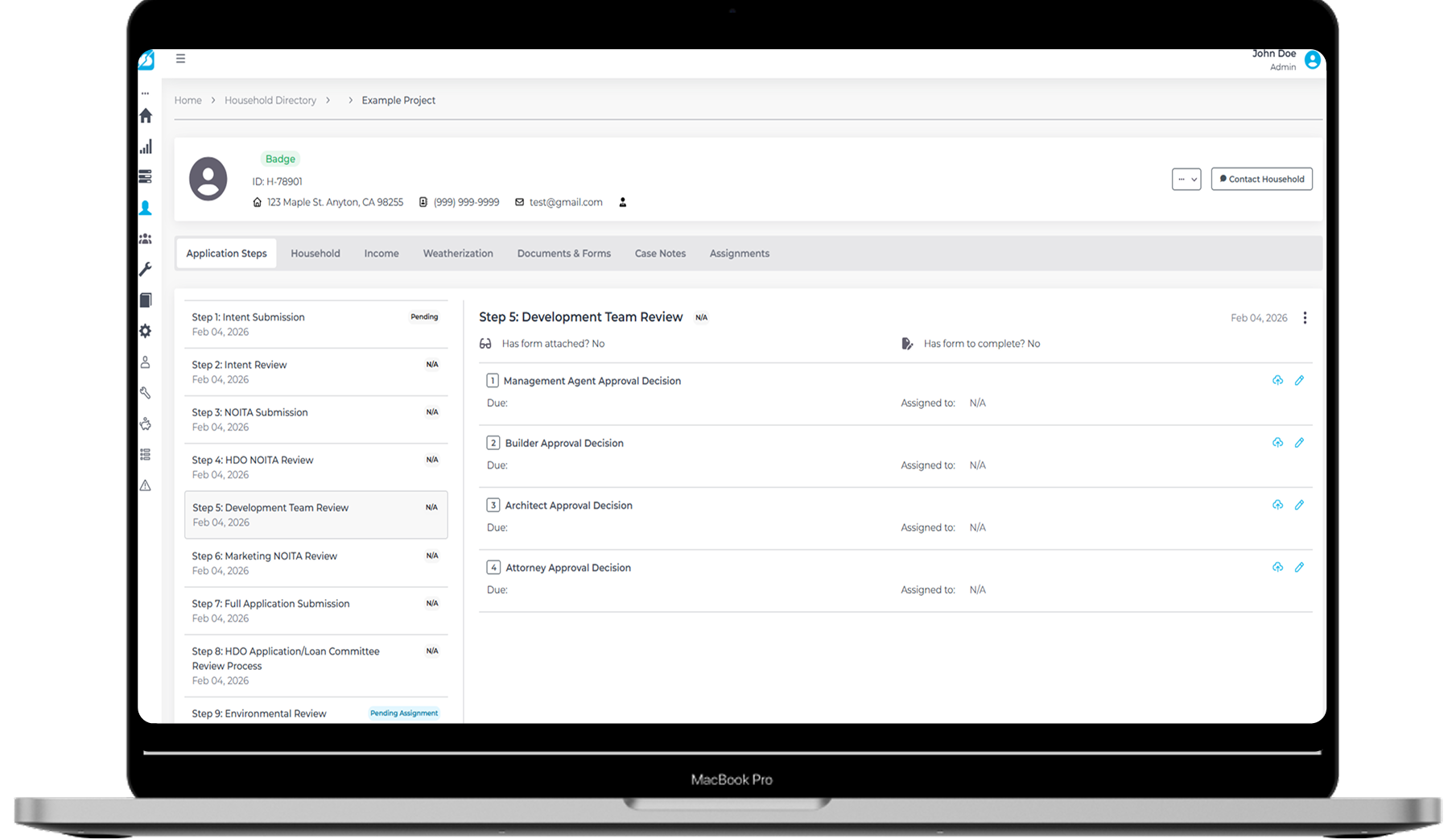
Case Management and Workflow
Every case moves through a defined workflow: intake review, document verification, eligibility determination, approval, and payment. Every step is tracked, timed, and auditable. Caseworkers see assigned cases, outstanding tasks, and upcoming deadlines in one view.
- Configurable routing: round-robin, availability, case type, or manual
- Escalation rules surface stalled cases before they become compliance problems
- Every status change and note captured with user identity and timestamp
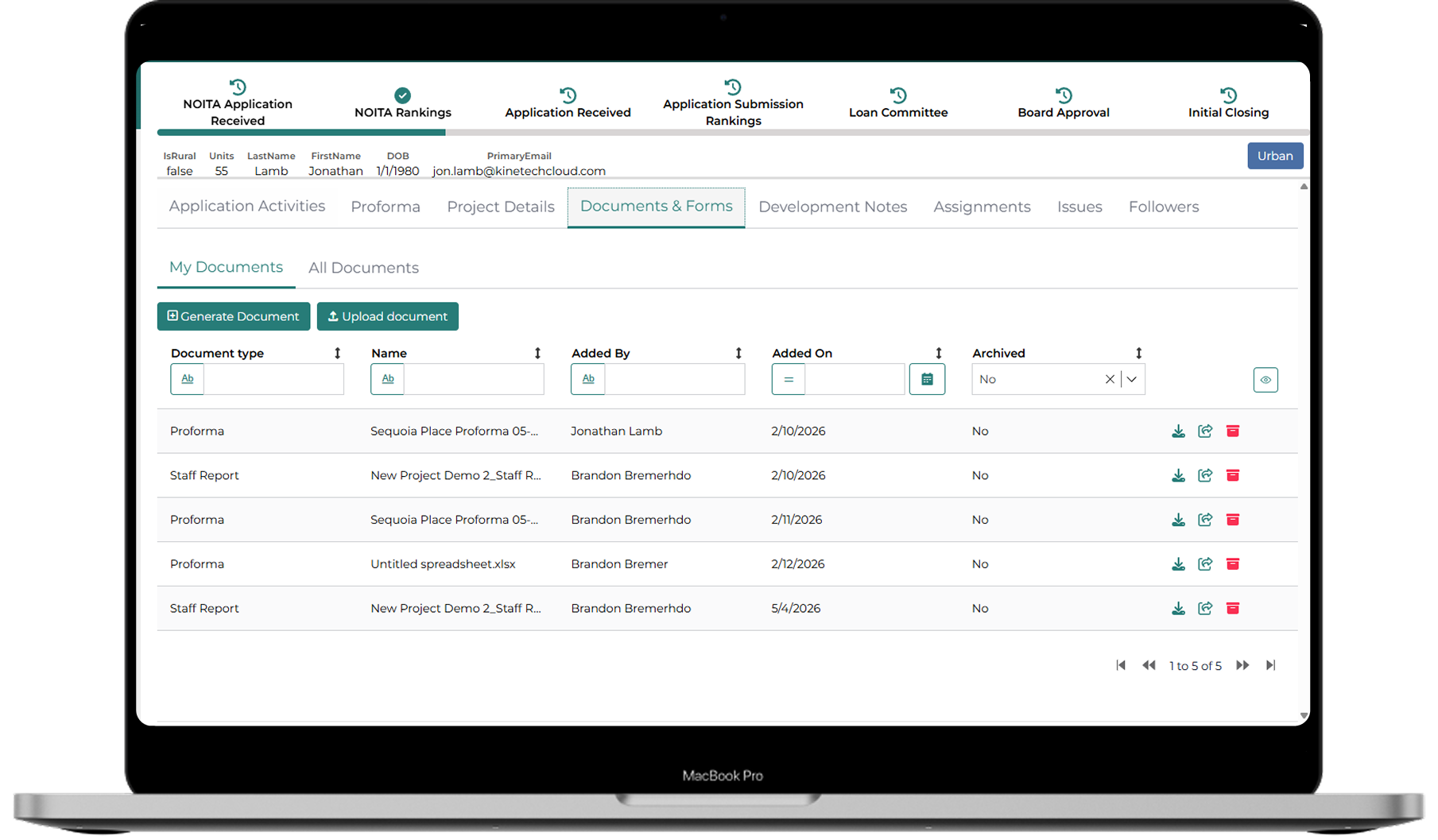
Fund Management and Braiding
Most programs don't run on a single funding source. LIHEAP and state dollars. Federal HOME funds, local CDBG, and philanthropic grants. Each source has its own rules. Conductor tracks every funding source in real time, including balances, obligations, disbursements, and period-of-performance limits.
- Automatic cost allocation when a case qualifies for multiple sources
- Attribution trail maintained for federal audits without manual reconciliation
- Integrates with the agency's payment and finance systems for money movement
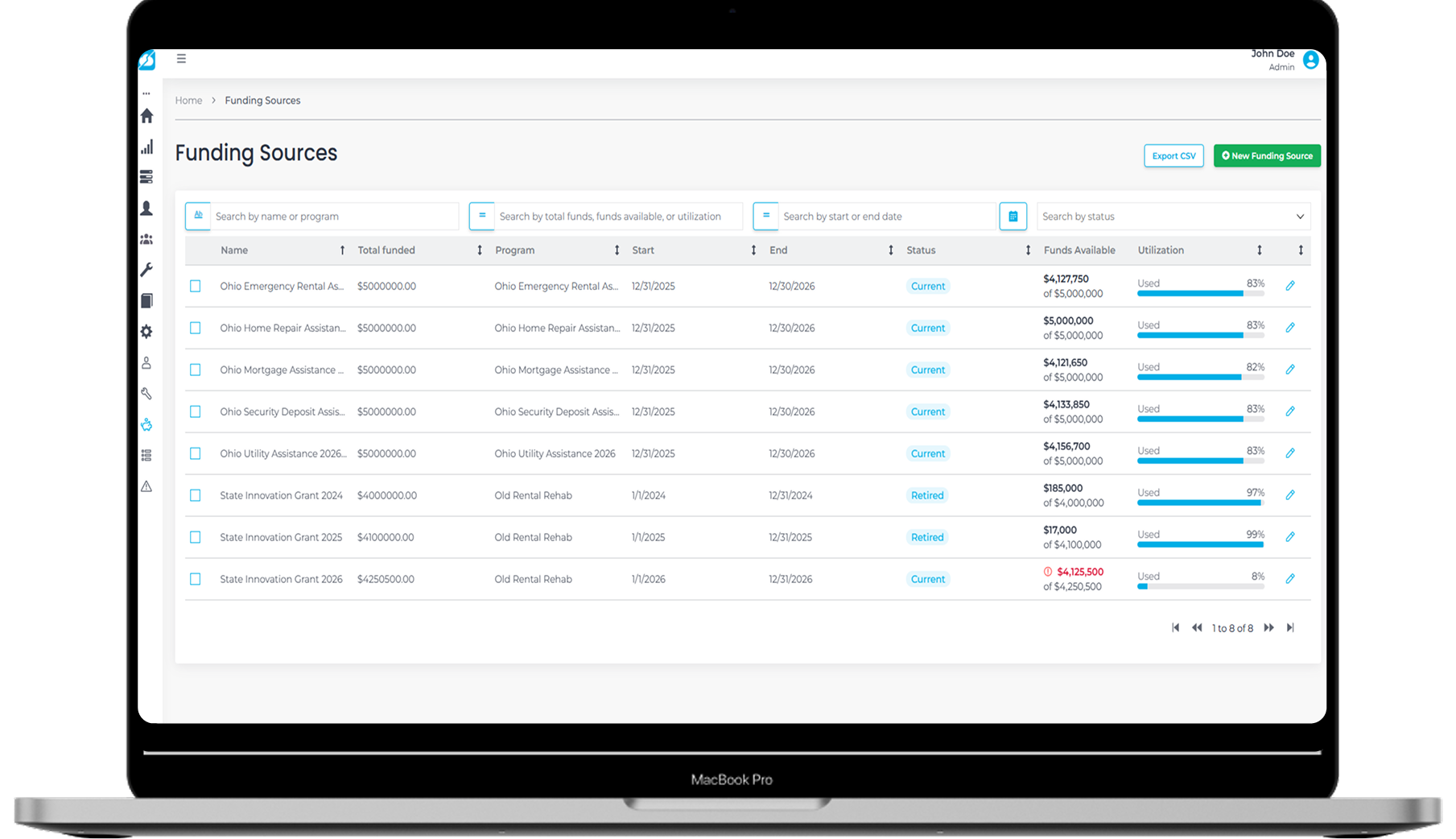
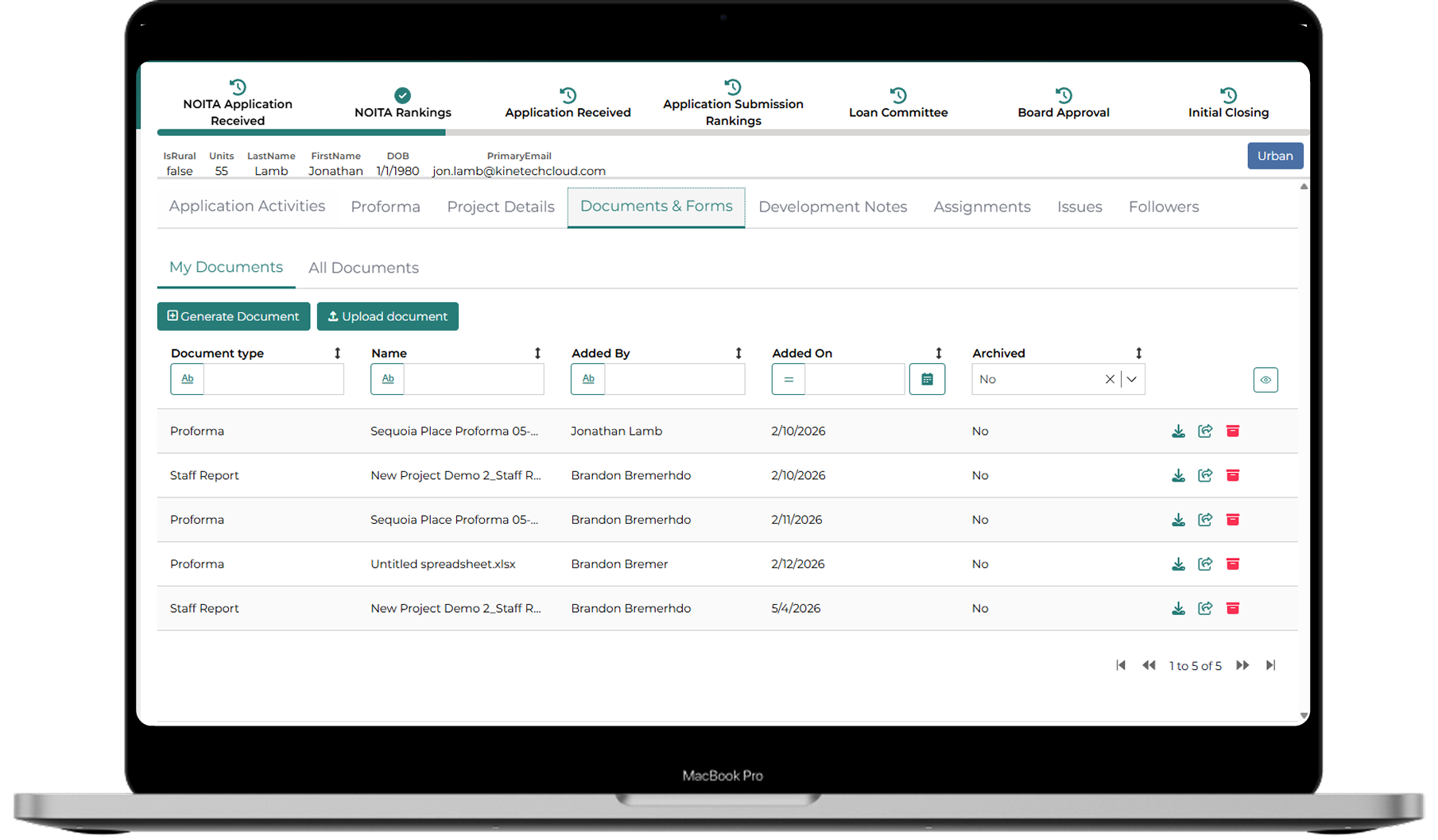
Document Management and Processing
Every document is classified, versioned, and linked to the step that requires it. For high-volume programs, Conductor uses Amazon Textract to extract data from uploaded documents and map values directly into case fields. Staff review exceptions rather than keying every document by hand.
- Income verification letters, utility bills, pay stubs, and tax returns processed automatically
- Configurable document generation: approval letters, denial notices, compliance reports
- Electronic signature built in for documents requiring legally binding sign-off
Notifications and Communications
Email and in-platform notifications fire automatically as cases advance, tasks are assigned, documents are requested, deadlines approach, or @mentions are posted. Templates are admin-configurable. Every notification carries case context and a deep link to the work. Communications stay inside the platform with the audit trail attached.
- Process-triggered email tied to case events, not generic status messages.
- Threaded comments and @mention alerts keep conversation on the case record.
- SendGrid, SMTP, TLS/SSL, and OAuth 2.0 all supported (Microsoft 365, Google Workspace).
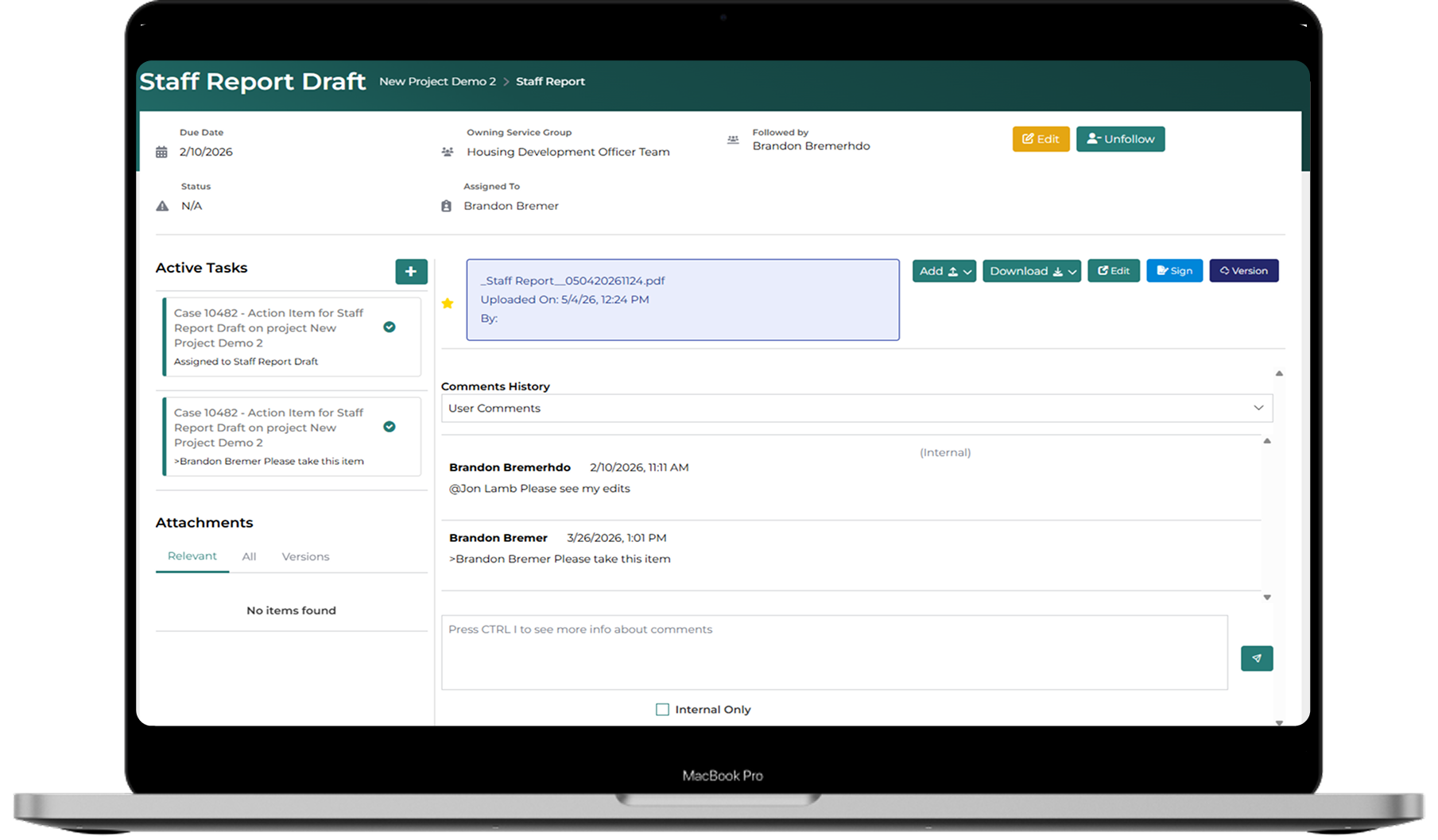
Reporting and Transparency
Every change to every record is logged automatically: before-and-after values, user identity, and timestamp. The audit trail is immutable and supports federal monitoring visits, FOIA requests, and compliance reviews without requiring staff to reconstruct what happened.
- Real-time dashboards for caseload distribution, processing times, and fund balances
- OData feed consumable by Power BI, Tableau, and Excel directly
- Public-facing dashboards available for programs with public accountability requirements
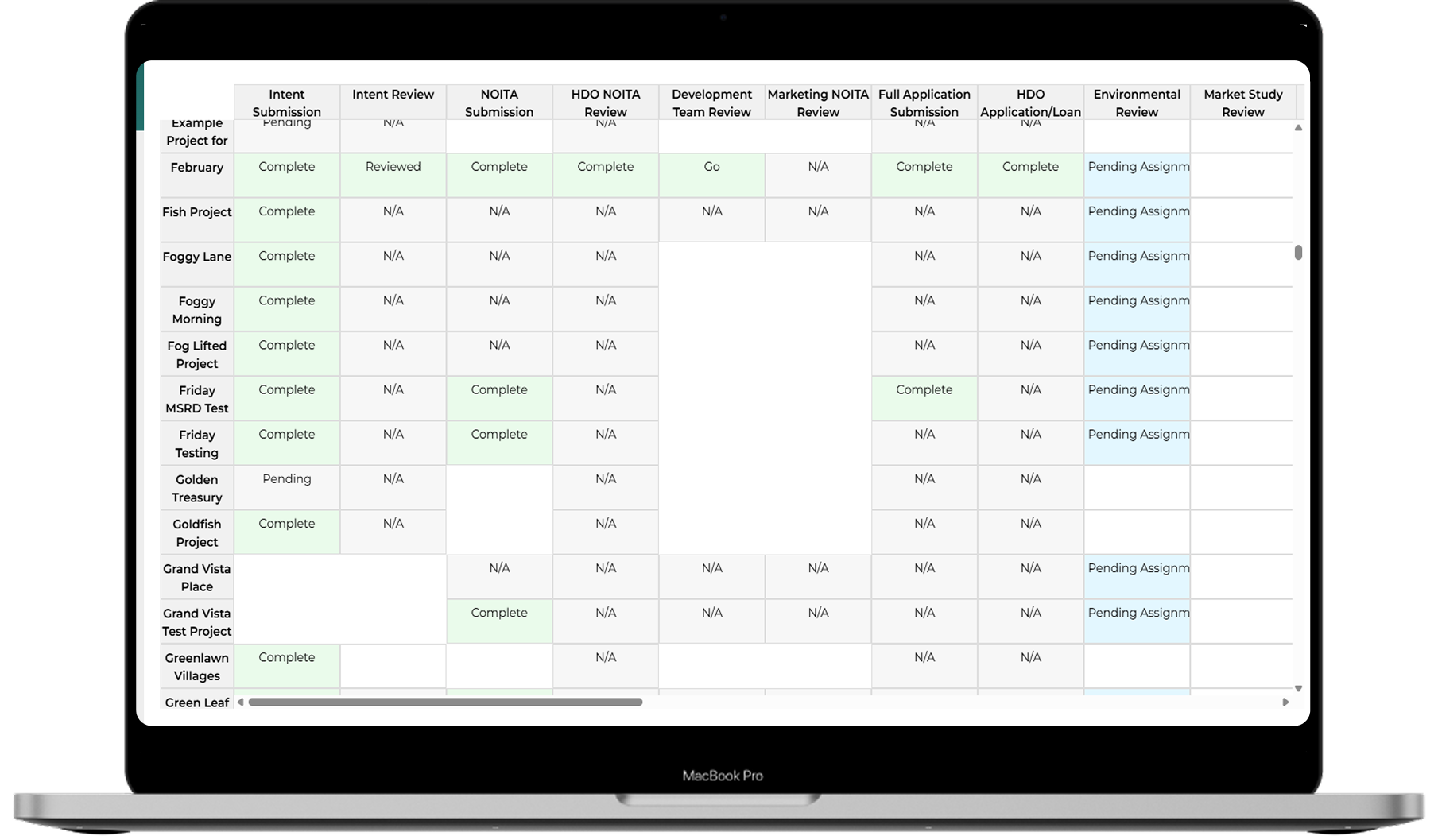
Resident and Applicant Experience
The public-facing portal works on a phone, saves progress, and sends notifications tied to actual case events, not generic status messages. Not every applicant can self-serve: caseworker-assisted intake handles all scenarios on the same platform.
- Multilingual support managed through the admin interface, no development work required
- WCAG 2.1 Level AA, tested with screen readers (NVDA, JAWS, VoiceOver)
- Role-based interfaces for caseworkers, providers, administrators, and oversight staff
.png?width=1221&height=1018&name=Resident%20and%20Applicant%20Experience%20(2).png)
AI that does real work, with guardrails that matter.
Document processing
Where document extraction is performed by AI, the audit trail records which values were AI-extracted and which were human-entered. Low-confidence extractions are flagged for human review before they affect a case record. The capability is the same automation described in the document management section above; the AI framing is what makes it auditable.
Case Summarization
For complex cases with long histories, Conductor can generate a structured summary for caseworker review and supervisor handoffs. The summary is marked AI-assisted in the audit trail and is always editable before it affects a case record.
Narrative Generation
For reports, decision letters, and case narratives that require structured prose, Conductor can generate a draft from the case record. The draft is marked AI-generated in the audit trail and is always editable before it leaves the platform. Staff retain authorship; the AI handles the first pass.
Agentic Workflows
Bounded, repetitive tasks (appointment reminders, document follow-up, deadline escalation) can be handled by agents that log every action and escalate to human staff when something falls outside the expected pattern. Agents are not given authority to approve cases, release funds, or make eligibility determinations.
Predictive Analytics
Applications can be scored for approval likelihood, delay risk, and fraud indicators. Trend analysis and resource forecasting support program planning. Scores and projections are advisory and presented alongside the signals that produced them.
Conductor is AI-ready. Every capability above is available when your program is, with the guardrails configured to match your compliance posture.
Your data stays yours. Agency data used in AI processing stays within the compliance boundary of your deployment. AI providers operate under contracts that prohibit training on your data.
Built for the requirements of public programs, not retrofitted to meet them.
Certifications
- Built on FedRAMP Authorized Platform
- SOC 2 Type II. Annual attestation.
- ISO 27001, ISO 27017, ISO 27018.
- FedRAMP & StateRAMP aligned deployments available.
- NIST SP 800-53 alignment.
- HIPAA. Business Associate Agreements available.
- CJIS. Compliant configurations available.
- WCAG 2.1 Level AA and Section 508 across all interfaces.
How it works: Access control
Staff authenticates through your agency's existing identity provider (Microsoft Entra ID, Okta, Ping Identity, and others) via SAML 2.0 or OpenID Connect. Permissions are role-based and enforced at the data model level, not just the interface.
Data protection
AES-256 encryption at rest. TLS 1.2 or higher in transit. Every data modification is logged with before and after values, user identity, and timestamp. The log is immutable and exportable for SIEM integration or compliance review.
Data ownership and exit
Agency data is scoped within your deployment environment. If the engagement ends, you receive a full data export in an open format and a certificate of data destruction. No data lock-in. No ambiguity at exit.
Deploy where your program requires it. Connect what you already have.
Deployment
Conductor is cloud-native and cloud-agnostic. Built for containerized deployment, it runs on the cloud environment of your choice. Conductor can deploy seamlessly with Kubernetes for real-time failover and autoscaling. We bundle AWS commercial cloud as part of our standard delivery. If your agency prefers a different cloud, that's just as easy. We deliver on any cloud you choose. Kinetech delivers Conductor as a fully managed service or supports the application in your environment.
- AWS GovCloud (FedRAMP Authorized)
- AWS Commercial
- Azure Government
- Azure commercial
- Agency-managed private cloud
- Existing Mendix environment
- On-premises Kubernetes or OpenShift container deployment, including air-gapped opera
Integration
Your existing systems stay. Conductor connects to them. Data can be migrated into Conductor or remain where it lives today. We don't require wholesale replacement.
- REST APIs with OpenAPI specification
- SOAP for legacy enterprise systems
- File-based integration (CSV, XML, JSON, Excel)
- Webhooks for event-driven automation
- OData feeds for Power BI, Tableau, and Excel
- Direct database connectors where API access isn't available
- Out-of-the-box connectors: SSO, document signature, geospatial, identity and income verification, address validation, ACH and payment processing, federal reporting portals
Configurable platforms need a different delivery model. We've built one.
Conductor implementations run on an agile cadence, with two-week increments of working software validated by your team against real data. Most go live within three to six months.
By go-live, your program administrators update forms, eligibility rules, and workflows through the admin interface, without returning to a development contract. Dependency isn't our business model. Partnership is.
The first conversation is where this starts.
A technical briefing is the fastest way to get real answers. We'll walk through the architecture, deployment options, integration approach, and compliance posture in the context of what your agency actually runs. No generic demo. No slide deck disconnected from your situation.